
Funded by the European Union. Views and opinions expressed are however those of the author(s) only and do not necessarily reflect those of the European Union or the European Education and Culture Executive Agency (EACEA). Neither the European Union nor EACEA can be held responsible for them.

Smart Skills Train-the-Trainer (TTT) Toolkit

Welcome to the central resource hub for the Smart Skills Train-the-Trainer (TTT) Programme. Designed to bridge the gap between innovative pedagogy and practical, real-world application, this toolkit empowers trainers, rural developers, and educational organisations to drive the digital and green transformation of European agriculture.

What’s Inside the Toolkit?

Our comprehensive, open-source package equips you with everything needed to lead engaging, high-impact training and collaborative regional workshops:

Trainer Presentation Slides

A structured, landscape PowerPoint presentation designed for trainers to introduce the Smart Skills project, objectives, and core technological solutions.

Smart Skills Train-the-Trainer Module Manual: A comprehensive guide supporting trainers in rolling out our 6 Smart Skills core courses and 30 modules. The manual is designed as both a teaching companion and a reference guide. It provides trainers with clear, practical guidance on how to deliver, adapt & evaluate each module, ensuring that the learning experience is relevant, engaging & grounded in real-world agricultural practices.
Workshop Facilitation Guide: A practical roadmap for planning, implementing, and capturing actionable insights from regional collaboration Design Thinking workshops.
Design Thinking Templates: A robust collection of 20+ ready-to-use PDF templates—including a dedicated SmartSkills Action Plan template—to guide participants through problem-solving and localized strategy building.

Empowering Regional Collaboration

Built around active, experiential learning, the TTT toolkit helps trainers foster multi-stakeholder dialogue and co-create practical solutions tailored to regional needs. By turning theoretical knowledge into individualised action plans, we ensure that digital literacy and sustainable practices take root directly on the ground.
Design Thinking Regional Collaboration Framework

What is the Framework?

A model to empower trainers, educators, farmers, advisers, rural community leaders and regional leaders to co-create solutions for sustainable, digital agriculture. Built on Design Thinking, this Smart Skills framework guides multi-stakeholder collaboration to turn smart farming concepts into practical regional action plans.

Why Use This Framework?

Build capacity for collaborative problem solving
Support region-specific digital and sustainable solutions
Empower participants to design actionable prototypes
Promote peer learning, systems thinking & innovation
Strengthen uptake of Smart Skills resources at local level

What is Design Thinking?

Design Thinking is a creative, people-centred approach to solving complex problems. It helps communities and businesses explore challenges in new ways — focusing on the needs of real people, encouraging collaboration across sectors, and moving quickly from ideas to practical, testable solutions.

Through the Smart Skills project, we encourage the use of the Design Thinking process to help local agricultural stakeholders — from farmers to educators to policymakers — work together to tackle the twin transition, approaching digital tools and agri-tech as valuable resources, and build more sustainable systems in their region.

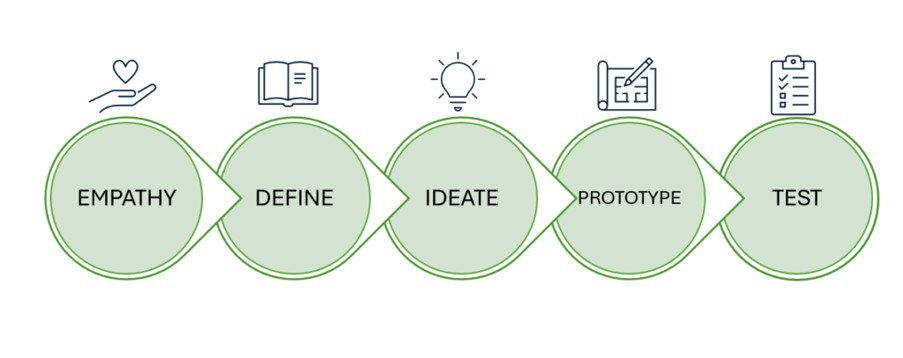
The 5 Stages of the Design Thinking Process

Each stage in the Design Thinking process helps communities move from understanding a local challenge to developing real-world, locally grounded solutions. Here’s a quick overview:

Preparatory Phase

Focuses on recruiting & selecting the right participants and using engaging ice breakers to build trust, set expectations, & create an open, collaborative atmosphere for the Design Thinking workshop.

Understand the people and systems behind the problem.

Talk to those affected by the challenge, like farmers or primary food producers, and adult or VET educators – and learn about their challenges, behaviours and frustrations. Use empathy maps, interviews and local data to build a clear picture of their reality.

Identify the real problem to solve.

Turn what you’ve learned into a focused, human-centred challenge. Move from broad issues like using high-tech tools, to clear design questions like “How might we help farmers become more data-driven without compromising resources?”

Generate as many creative ideas as possible.

Encourage open brainstorming. Build on each other’s ideas, challenge assumptions, and explore solutions that might be innovative, unexpected, or even unconventional — from product ideas to new processes, services, or community campaigns.

Make your idea visible and testable.

Create simple mock-ups, sketches, role-plays or storyboards to bring your idea to life. Don’t aim for perfection — just something users can interact with and react to. Prototyping helps teams turn concepts into something real.

Get feedback and improve your idea.

Present your prototype to real users, peers or community stakeholders. Gather honest feedback and reflect on what works, what doesn’t, and how to improve it. Testing helps turn ideas into practical, usable solutions.

Post-Workshop Phase

Encourages participants to reflect on their learning using guided templates & supports them in transforming ideas into concrete, collaborative Action Plans that foster the development of resilient circular communities.

Translated Downloads (PDF)

Translated Downloads (PDF)

Translated Downloads (PDF)

menu